
It is often easier to manage someone from another culture than someone from the same street.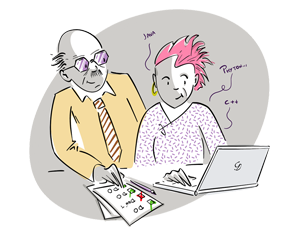
Some of the most effective working relationships I see today are not between similar people. They are between people who, on paper, should struggle to understand each other.
A slightly uncomfortable observation.
Many Gen X managers find it easier to work with someone from another culture than with someone from the same street, someone who could be their best friend’s child.
Apparently because mindset matters more than culture.
Why working across cultures can be easier than working across generations
In the past week I spent time with senior leaders in two leading organisations in professional and financial services. Once more it became clear how challenging it is to bring teams to the level of performance required in today’s economic climate.
There is a quieter truth behind this: Many Gen X managers find it easier to work with younger colleagues from different cultures than with those from their own.
Gen X, roughly mid 1960s to early 1980s, grew up with independence, limited supervision and the expectation to figure things out. Many of those they manage today belong to Gen Z, born from the late 1990s onwards, raised in a more connected, structured and closely observed environment, with stronger emphasis on feedback, safety and fairness. Many of them grew up in materially comfortable households.
How is it that managing someone from another continent can feel easier than managing someone from the same street? At first glance that sounds odd. Cultural differences should create more misunderstanding than working with someone from your own environment.
In reality, mindset trumps culture.
The underlying mindset of many western-grown Gen X leaders is not far removed from that of much younger people from non-Western cultures.
Operate in discovery mode rather than defensive mode
Jonathan Haidt describes in The Anxious Generation two ways people move through the world.
Discovery mode is about trying, failing, fixing and leaning in where others give up.
Defensive mode is about looking successful, avoiding mistakes, avoiding risk and avoiding ambiguous situations.
If I ask my students, “Would you try something that you don’t know you will succeed at?”, I often get a very quick “no way” as an answer.
Many Gen X professionals were raised in environments that naturally produced discovery mode. Less supervision. More independence. If something broke, you fixed it. No help anywhere near.
Professionals from emerging economies often operate the same way. Not because it is fashionable, but because progress required it. If you want to build a better life for yourself and your children, waiting politely for instructions is rarely the winning strategy.
Build on a mindset where diligence drives progress
“Diligence leads to prosperity” (勤劳致富)
In many non-Western cultures people are raised in what is often described as a Confucian mode of thinking.
Work hard. Take responsibility. Improve your situation. Wake up before others and succeed. Make a better life than that of the previous generation.
Many people who grew up in countries where prosperity is relatively new still carry this mindset. Sometimes they experienced scarcity themselves. Almost always their parents did.
The memory of how things used to be, and what it takes to move forward, has not been diluted yet.
It is worth acknowledging this. Many young professionals from these backgrounds bring a level of discipline and focus on progress that shows in how they learn and how they deliver.
Recognise what changes when wealth simply exists
The late Hans Rosling explained in Factfulness how societies move across four levels of living standards. Most people historically lived on levels 1 and 2, where daily life involved real constraints. In many countries today families have moved within one or two generations into levels 3 and 4, where basic stability is largely given.
When that shift happens, the relationship with work changes. It becomes less about necessity and more about fulfilment, identity or balance.
Understand how different starting points shape behaviour
If I left food on my plate, my father had a standard response: “The children in Biafra would fight for it.”
If there was twenty centimetres of snow, of course I took the bike to school. I cleared the pavement so the post-person, then respectfully called the postman, could do his job and the elderly could pass safely.
Snow was fun. No reason for alarm. No mummy-taxi; the car would not even start in the cold. School stayed open, and everyone made it on time.
And everyone thought it was normal. There was hot chocolate afterwards, if the job was done properly.
Effort and responsibility were simply part of life. Not a burden. Not a topic for discussion. Just how things worked.
Now, when I wash the car with a friend, the children sit inside, watching life go by on TikTok or whatever it is called.
Different starting points. Different assumptions about effort, comfort and how time is spent.
A different view on a joyful life. And I am not jealous.
Notice where expectations start to diverge
Some time ago a student cancelled his attendance for a fully booked three day programme two days before it started. Others had asked to join and had been told there was no space.
His message was brief: “Please make arrangements for my absence.”
I tried to reach him to see whether there was still a workable solution to his benefit.
One phone call. Two text messages. Two emails. No response.
What I did receive later was an invitation to the assistant dean’s office.
The student had filed a complaint. Apparently I had harassed him by attempting to contact him on the weekend. The world upside down. I would have called the student in.
What struck me was not the complaint itself. It was the raging gap in expectations.
Stop tiptoeing and learn to give feedback properly
Back to this week. I worked with senior leaders in two organisations on something that looks simple but is surprisingly difficult. Giving feedback.
Giving feedback safely is a skill. It can be learned.
It requires precision, timing and professional empathy. Kicking the ball, not the person. No soft approach, but in a way that transmits professional respect and helps someone improve without losing face.
When done well, it lands and opens the door to continuous learning.
Tiptoeing does not. Making life easy for the people you are trying to develop does not serve them. It may feel polite. It is neither useful nor kind.
Make expectations explicit to enable performance
So what works when people with very different assumptions about effort, responsibility and feedback need to deliver together?
In my programme Adjusting the Social Codex, the focus is simple: Make the implicit explicit.
Define how work gets done. Determine what effort looks like. Clarify how people engage with each other when things go well and when they do not.
Without that clarity, organisations drift into matching similar people to avoid friction. The opposite of the diversity they claim to value.
With it, very different people can thrive, merging generations towards joint prosperity and safe succession.
What this requires from leadership
- a) Define what must be done … give space on how it is done … be clear when extra effort is justified
As a leader, be explicit about what is to be delivered, at what level of quality and by when. That part is not a negotiation.
If you want to build motivation, leave room on the how. How the work is done and where it is performed can vary. That is where ownership starts.
Discretionary effort is not something you demand constantly. It is something you invite at the right moment. Raise the bar to a level that is challenging but still achievable with commitment and good intent, and make it clear when it matters.
- b) Ask for more when it counts … and give back visibly
If you want extra effort, there needs to be a return. Give credit where it is due. Give feedback that helps people improve. Create opportunities for people to grow. Say thank you.
If the return is not visible, the effort will not repeat.
- c) Make growth tangible … show what it takes to move forward
Let people see where their effort leads. What improves. What changes. What becomes possible. Show them what it takes to move to the next level.
Not to become you. They will not.
But to understand what responsibility, judgement and impact actually look like in practice.
If you get up before dawn and do the work with love, things tend to move in the right direction.
Not immediately. But with time.
Break the silos in your organisation and Adjust your Social Codex?
If there is room for a boost in honest togetherness across generations in your organisation, let me know where I can be of value.
This is the core of my work on adjusting the social codex. Aligning expectations, unlocking discretionary effort and turning diversity into performance.
