
Doing the expected often produces the outcome that is already on the table.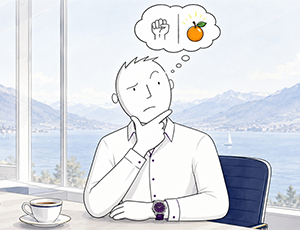
My father, a psychologist, taught me that many years ago. I recently applied it to two very different, objectively unfortunate, professional situations. The unlikely answer both times: an orange.
The Orange Technique in Better Business Communication
Two situations, one question
In the past two days, I was asked for advice on two objectively bad professional situations and how they might still be turned into unexpected positive outcomes.
The situations were very different, but they raised the same question: how do you offer someone a genuine fresh start without lowering standards, rewarding poor behaviour or acting from fear?
What my father taught me
One of the things I learned from my father, a psychologist: doing the expected often produces the outcome that is already on the table.
He once told me about a practitioner working with children who were considered extremely difficult to raise. I have not traced the orange itself, but the approach sits in a real tradition. Practitioners such as August Aichhorn, and later Fritz Redl and David Wineman, challenged the idea that increasingly difficult behaviour should be met with increasingly severe punishment.
These children were accustomed to criticism, punishment and rejection. They expected adults to respond to bad behaviour with anger. Their skin had grown thick where the belt used to hit them. Punishment had become like their daily potato soup.
The story belongs to another time. The leadership problem it illustrates does not.
The practitioner sometimes did something completely unexpected.
He gave the child an orange.
At the time, an orange was rare and highly valued.
At first sight, this seems entirely wrong. Surely this rewards bad behaviour?
Apparently, it did not. The children’s behaviour gradually improved.
The orange did not excuse what had happened. It interrupted a pattern that had stopped producing any useful effect. He did not react to the trigger in front of him. He chose, deliberately, the one response the child had no defence against.
From oranges to organisations
The same happens in organisations.
Poorly managed people can become immune to inputs that always arrive in the same form. More criticism. More pressure. More instructions, meetings and deadlines. More potato soup.
The manager reacts to the trigger. The employee, triggered in return, delivers the response one could predict. The situation gets harder, the solution gets farther.
This is where intentional leadership begins: waiting until after the trigger and selecting the response most likely to work.
Sometimes that intervention is direct challenge. Sometimes it is a firmer standard. Sometimes it is silence, a question, distance, or an unexpected gift.
The business equivalent of the orange is not praise for poor performance. It is a credible expression of respect combined with complete clarity about what must happen next.
What it can sound like
It may sound like this:
“Our recent interactions have not been what either of us would have wanted. I imagine they were unpleasant for you as well.
I want to tell you explicitly that I hold you in high regard. I respect your professionalism, your knowledge and the courage you show in your work.
Precisely because I value working with you, I do not want us to remain trapped in this pattern.
What would you think about putting a full stop behind this episode? We cannot change what happened, but we can decide how we work together from today onwards.
I would like us to start again with mutual respect, openness and clear expectations. What would you need from me for that to become reality?”
What changes
The power of the orange lies in the unexpected combination of genuine goodwill and uncompromising standards.
It does not erase the past. It changes the conditions under which the next interaction takes place.
