
The uncertainty is real. The stagnation is optional.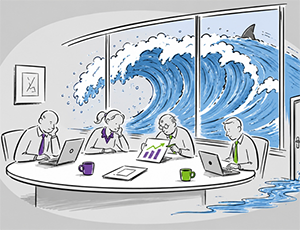
Corporate Reflux and the organisational tendency to stop digesting reality.
An executive in the banana trade once gave me a piece of advice:
“Take the first loss. It is always the best.”
Many organisations are waiting for uncertainty to pass.
I am no longer convinced it will.
A reflection on Corporate Reflux – the organisational tendency to stop digesting reality.
#Leadership #Strategy #CorporateReflux #Transformation #FutureOfWork
The uncertainty is real. The stagnation is optional.
Corporate Reflux and the organisational tendency to stop digesting reality.
Energy prices are volatile. More up than down.
Artificial intelligence is transforming entire professions at a pace that keeps surprising us.
Geopolitical tensions challenge basic assumptions of the world order. Organisations are under financial pressure and legal scrutiny. Workforce expectations have changed and mutual loyalty vaguely conditional. Younger generations ask different questions about work, progression and “me-time” than those who built their companies.
For many leadership teams, it feels as though every variable is moving at once. By the time the board meeting minutes have been approved, the world they describe may no longer exist.
The natural response is caution. More information. Another consulting project. Another committee. One more quarter. The hope that the sun will shine again.
After decades of conversations with executives, managers, team members and students, I increasingly wonder whether uncertainty itself is really the problem.
What I observe far more often is hesitation.
Corporate Reflux: when organisations stop digesting reality
I call this Corporate Reflux: the managerial tendency to reject uncomfortable realities rather than digest them, adapt to them and act upon them.
Perhaps it is related to what I previously described as the Mikado Effect. When every move appears capable of triggering unintended consequences, leaders become reluctant to move at all.
The result is stagnation.
Today’s uncertainty is different in one important respect: the speed and number of simultaneous changes.
Over the past few months, whether I was speaking with executives in insurance, manufacturing, shipping, healthcare, education or financial services, I kept hearing variations of the same concern.
An automotive executive in South America described how traditional European product-development cycles no longer keep pace with the market reality. Other executives spoke about increasing dependence on Asian product-development partners because of their speed, capacity and economics. The very dependencies that helped organisations move faster are increasingly becoming sources of strategic risk.
Many executives still speak about uncertainty as though it were a temporary condition.
I am no longer convinced.
The same theme appears in discussions on artificial intelligence. Much of the debate focuses on what AI can do. The more interesting question may be what organisations need to change because of it. In some environments, AI writes the report, prepares the presentation and summarises the findings. What’s next? The tool for increased productivity is there, but bears fruit only if organisations adapt how they work.
The pattern appears elsewhere. A struggling team member remains in place. An outdated process survives. A product line continues consuming resources long after it stopped creating value. A strategic priority is discussed but never committed to.
Everybody sees the issue.
As I described in “The Mikado Effect”, nobody wants to be the one to move first.
The instinctive response: more process, less progress
When uncertainty increases, organisations often respond by adding process.
New committees are formed. Governance structures expand. Reporting requirements increase. New departments appear to tackle the challenge of the day.
The Germans have a wonderfully cynical expression: “Jeden Tag wird eine neue Sau durchs Dorf gejagt.”
Over the years I have watched organisations fund Digital Transformation Offices, Innovation Offices, ESG Offices, Sustainability Offices and now AI Offices. Too often, the overhead grows faster than the capability they were created to build.
Every additional layer demands management attention, slows decisions and creates distance between leaders and the realities they are supposed to address. The organisation becomes busier while silently gaining weight.
Quality rarely emerges because a quality department was created. Innovation rarely flourishes because an innovation department was added to the organigram.
Capabilities become real only when they influence how people think, decide, build, sell, hire and lead. Until then, they remain programmes, reports and aspirations.
Faced with rapidly changing conditions, many organisations end up governing problems they have not yet decided to solve.
How leaders regain control
The organisations that navigate uncertainty best are rarely those with the most detailed forecasts. They are usually the ones that confront reality fastest and act on it.
During Strategiser Workshops© and executive coaching sessions, I often ask a simple question:
What, other than courage, do you need to take a decision, now?
Taking risks and making difficult calls is part of management. Leadership matters precisely because the answer is not obvious.
In my experience, most leadership teams already know where to start.
Get the team right. Most leaders know long before they act that someone is not performing, not collaborating or no longer fits the direction of the organisation. Yet they hesitate because the consequences are uncomfortable. The disruption is real. So is the cost of waiting.
Define the Must Win Battles. Not twenty priorities. Not the flavour of the month. The few issues that genuinely determine success over the next 12 to 36 months. Agree on them, pressure-test them and stay with them until they are resolved.
Build the next generation of leaders. For centuries, expertise was transferred through apprenticeship. The terminology may have changed, but the principle has not. Every critical role should have identified and nurtured successors. Every talented employee should see a future. If upward mobility disappears, your best people will create it elsewhere, sometimes as competitors.
Integrate rather than isolate. AI, sustainability, quality, diversity and innovation do not become important because they appear on an organisational chart. They become important when they influence everyday decisions. Strategic priorities that remain side programmes rarely become strategic capabilities. Left isolated for too long, they risk becoming stones around the neck of the organisation rather than sources of progress.
Prune relentlessly. Every organisation accumulates legacy: products that once mattered, processes that once worked, departments that once solved important problems and sometimes even roles that were essential in a previous phase of the business. Removing them is rarely a purely rational exercise. Like removing yellow leaves from a plant, it is a form of grief. Yet keeping them indefinitely deprives the next generation of initiatives of light, energy and resources.
The conversation most leadership teams would benefit from, now
Many years ago, a senior executive in the banana trade shared a simple piece of advice with me:
“Take the first loss. It is always the best.”
I have yet to meet the executive who told me they should have waited longer.
The decisions we postpone rarely become easier. They usually become more expensive.
If you are part of a leadership team, now may be the time to create the space for a different kind of conversation. Not another quarterly review. Not another operational update. A genuine discussion about reality.
Do we have the right people? Are we pursuing the right battles? Who are tomorrow’s leaders? What should we stop doing? What are we refusing to see because the implications are uncomfortable?
These are not questions that can be resolved between agenda item 7 and agenda item 8 of a board meeting. They require leadership teams to step away from day-to-day firefighting, challenge assumptions, confront uncomfortable truths and make deliberate choices about the future.
The discussion may be uncomfortable.
As with any major life choice, if it does not feel uncomfortable, it is probably not a real choice.
While uncertainty is real, stagnation is a choice.
Not a good one.
