
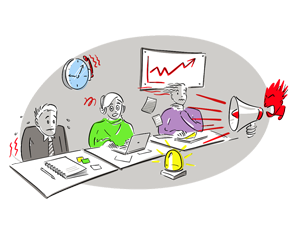
Last week’s Strategiser© Workshop with the top team of a global industry leader was a milestone. The analysis was solid, and the material was well prepared. But the real challenge was not the information itself; it was about encouraging the team to think beyond the data, trust their experienced intuition and confront the realities of their situation. This shift in perspective is where the true transformation happened.
What capability looks like in the age of AI
Over the past year, I have observed consistent shifts in organisations, including the erosion of real problem-solving capability, the confusion between those labelled as “talent” and those who actually get things done, and the decline in synchronous communication.
Last week’s Strategiser© Workshop with the top team of a global organisation confirmed the need to define the remaining skillset in the age of AI.
The environment keeps moving while organisations are still making sense of the last shift.
Make the shift from finding answers to sharpening judgement
In the Strategiser© session, there was no shortage of data. The analyses looked good. What was missing were clear, owned opinions. Discussions drifted into negotiation and away from problem-focused decision-making, with people playing positions rather than confronting inconvenient truths.
A line from my physics professor remains relevant: “Every complex problem has a simple solution – and it’s wrong.”
AI now produces that simple solution instantly. It is structured, fast, and convincing enough.
The World Economic Forum shows that more than 70% of employers rank analytical
thinking as the most critical skill, followed by resilience, leadership and social
influence. Producing answers is easy. The ability to question them, test them against
reality, and stand behind them is what matters.
When the tool gets smarter than the user: beware of cognitive offloading
The effort required to produce good-looking work has dropped sharply. Drafting, structuring and initial analysis can now be done in minutes.
Research from Microsoft indicates that around 80% of employees and leaders feel they lack time or energy to do their work, while more than half of leaders expect productivity to increase. This creates a paradox. Work becomes faster, but capability does not improve. Cognitive offloading allows strong outputs without corresponding understanding.
Used well, AI accelerates thinking. Used blindly, it replaces it.
Over time, this distorts perception of what is actually happening.
Do not lose the feel for the situation
When I drive backwards with my 30-year-old classic car, there are no sensors. If I go too far, I scratch the car. I need to rely on my own sense of distance.
The same pattern is emerging in organisations. The more systems provide answers, the easier it becomes to lose the feel for what is actually happening. Outputs are trusted because they look right. Judgement becomes dependent on the tool.
“Fingerspitzengefühl” still matters. It is the ability to sense when something is off, even if it is not immediately visible in the data.
Rebuild skill and courage for real communication
Messages replace conversations, and responsibility disappears between the many lines on the organigram.
Problems do not get solved in messages. They get solved when people put a view on the table, get challenged, push back, and stay until they get it right.
That is the work you are paid for.
Learn and dare to take ownership
The combination of AI and growing complexity changes how decisions get made. Information is abundant. Certainty is rare.
AI fluency is becoming a baseline expectation in hiring. Employers hire to reduce risk, not to bet on potential.
The litmus test is whether the person entrusted with the work can combine AI output with sound judgement, assert and defend the recommendation, and implement it.
That is where maturity is visible.
Build capability in the work
The current economic environment forces organisations to reduce travel, postpone gatherings and limit training spend while expecting higher performance. Capability needs to be built in the work.
At W-focus, teams work on real problems under real constraints and develop solutions they implement themselves. The objective is not a presentation, but an outcome.
Focus on what matters now
Across these situations, a consistent profile emerges: people who use AI without depending on it, detect weak reasoning, communicate clearly, and take ownership for outcomes. These are not new skills, but they are now required at the same time.
Act before it becomes urgent
Technology reduces effort. It also creates cover for those who lack the courage and skill to decide. As output becomes easier to produce, the real difference shows when someone has to make the call.
Which decisions are you delaying today that will become harder to make tomorrow?
If this resonates, I am open to a direct and honest conversation on how to address these issues in your organisation.
